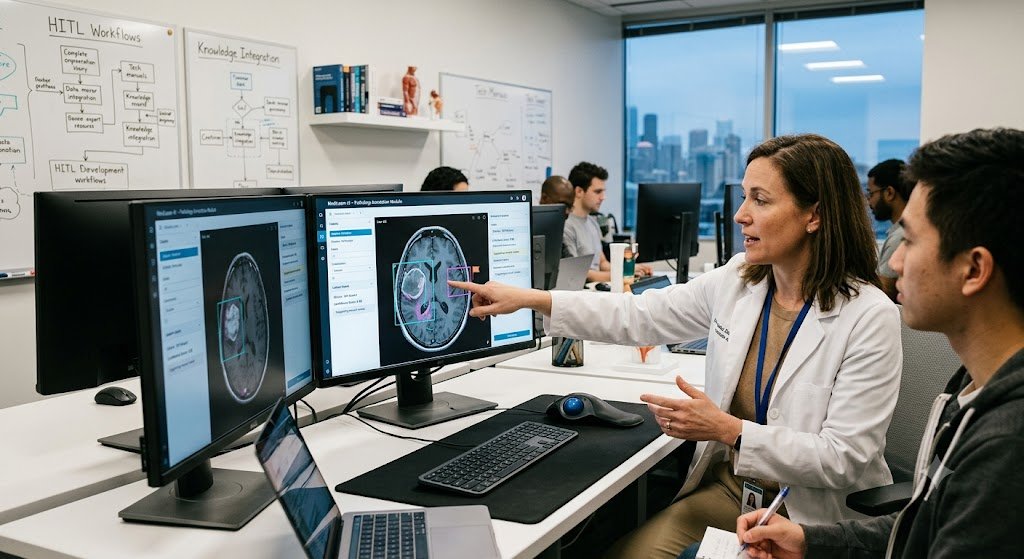
The tech industry has spent years telling a specific story about the artificial intelligence boom: that it belongs entirely to software developers, machine learning engineers, and data scientists. The unspoken rule was that if you didn’t have a computer science degree or a background in advanced mathematics, you were just a spectator.
But as AI moves out of research labs and into enterprise workflows, companies are hitting a practical bottleneck. The challenge isn’t a lack of computing power or algorithmic sophistication—it’s a lack of context. For AI to be useful in a commercial setting, it needs to understand the jargon, regulatory boundaries, and operational realities of specific industries. This friction has created a distinct career path for non-technical professionals: the domain expert as an AI trainer.
The Limits of General AI
Large Language Models (LLMs) are capable generalists. They can summarize articles, draft emails, and generate basic code because they have crawled vast amounts of public internet text. However, their utility drops when they encounter specialized business environments. An out-of-the-box LLM does not understand the compliance workflows of a mortgage brokerage, the specific diagnostic codes used in a hospital, or the legal precedents required for a corporate merger.
To fix this, enterprises rely on a “Human in the Loop” (HITL) framework. Instead of trying to teach engineers the intricacies of complex, highly regulated industries, companies are hiring industry veterans to evaluate AI outputs, fix hallucinations, and build high-quality training datasets.
Hiring for Context, Not Code
This shift is actively reshaping the job market. Organizations across legacy sectors are looking for professionals who can align and fine-tune AI models using real-world experience.
In the mortgage and finance sectors, companies like Kastle—which builds AI-driven voice agents to automate lending workflows—are hiring part-time AI trainers. The role doesn’t require programming experience. Instead, candidates must have at least five years of customer service experience specifically with a mortgage servicer. These specialists use their knowledge of loan originations to teach the AI how to navigate complex customer inquiries without violating compliance rules.
A similar trend is playing out in architecture. Firms like Hickok Cole are hiring AI/BIM Specialists. Rather than looking for software engineers, they require six or more years of architecture and interior design experience, alongside mastery of industry tools like Revit. These experts focus on integrating AI directly into the actual workflow of commercial and residential development.
Nuance in Language and Education
The need for domain-specific oversight is especially obvious in fields driven by language and communication, where general models frequently miss cultural context or authentic tone.
Lilt, an AI-powered enterprise translation platform, recruits remote AI experts with native fluency in specific languages, such as Hmong, to review and annotate machine translations to ensure accuracy. On broader platforms like Toloka, data annotators are hired based on analytical skills and language proficiency rather than technical backgrounds.
Even education and sports organizations are building out these teams. Texas Sports Academy, a private K-8 school, employs AI Quality Analysts to evaluate automated SMS conversations against strict pass/fail criteria, ensuring the system communicates naturally. In higher education, traditional teaching roles are expanding into tech enablement. Bank Street College of Education, for instance, introduced a Math and AI Coach-Facilitator role to help teachers integrate AI tools into math curricula effectively.
High-Stakes Guardrails in Regulated Industries
While a mistake by a retail chatbot is a minor inconvenience, an AI error in a legal contract, a medical diagnosis, or an insurance underwriting decision can trigger lawsuits or regulatory penalties. In these sectors, human oversight is often a legal necessity.
This has led to highly specialized hybrid roles. In the legal market, firms like Alston & Bird employ Legal AI Solutions Analysts who use their background in legal tech and workflow design to build the specific prompts guiding generative AI tools. Gibson Dunn hires Litigation Attorneys with prompt engineering skills to handle AI-driven legal research and dispute resolution.
In insurance and pharmaceuticals, the requirements are even higher:
- Everest Group: The global reinsurance provider looks for AI Product Owners who pair machine learning implementation skills with a mandatory background in underwriting and claims.
- Merck & Co.: The pharmaceutical giant employs a Director-Pharmacometrics AI Lead, requiring a Ph.D. and over eight years of experience in drug development to oversee machine learning applications in clinical environments.
Moving Past the Hype
The rise of the AI trainer indicates that the future of work won’t be dictated entirely by those who write Python code. Instead, the utility of automated systems relies on people who understand how specific industries actually operate. Whether you work in mortgage banking, legal writing, translation, or clinical research, specialized industry knowledge has become a critical asset for building and refining corporate AI.

